


Most boat owners call three transport companies and get three wildly different quotes. One says $600. Another says $4,200. Neither explains why.
The gap isn’t dishonesty. It’s that boat transport pricing hinges on a single regulatory threshold most owners have never heard of, and it can double or triple a quote overnight. Distance matters less than people assume. Size, specifically width, matters far more.
This guide breaks down what actually drives the price, shows where the line sits between a cheap tow and an expensive oversize haul, and gives you the numbers to check a quote against before you sign anything.
Quick Answer: Boat Transport Cost Ranges
Boat transport in Australia typically costs between $500 and $12,000, depending almost entirely on boat size and width. Distance shifts the price within that range, but it rarely changes which range you’re in.
A small trailer boat under 6 metres usually moves for $500 to $1,500 within a state. A mid-size boat between 6 and 9 metres runs $1,500 to $4,000 for an interstate move. Anything wider than 2.5 metres jumps into oversize territory, where permits, escort vehicles, and route restrictions push costs to $4,000 or more, sometimes well past $10,000 for large cruisers and yachts.
These are starting points, not quotes. The next sections explain exactly why the numbers move the way they do.
The Real Cost Driver: Size, Not Distance
Most people assume a longer trip costs proportionally more, the way a flight or a courier parcel does. Boat transport doesn’t scale that way.
A 5-metre runabout moved from Sydney to Brisbane and a 5-metre runabout moved from Sydney to Melbourne will land in a similar price bracket, even though one trip is roughly double the distance. Fuel and driver hours do add cost, but they’re a smaller slice of the total than people expect.
What actually swings the number is whether the boat fits on a standard trailer within standard road dimensions, or whether it needs a low-loader, a pilot vehicle, and a permit. That single fact matters more than an extra 500 kilometres on the odometer.
Why Width Is the Number That Changes Everything
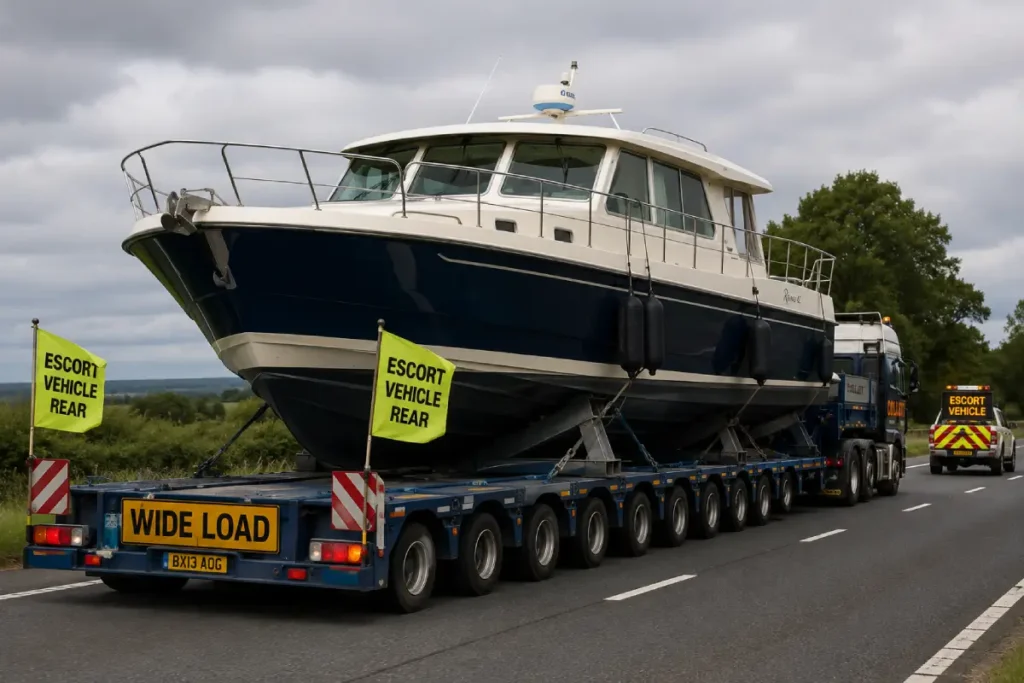
Here’s the threshold nobody quotes you upfront. Under the National Heavy Vehicle Regulator’s rules, a heavy vehicle and its load become classified as oversize once it exceeds 2.5 metres in width or 25 metres in length.
Cross that line and the job changes completely. An oversize vehicle that’s wider than 2.5m must carry four warning flags, each at least 450mm square, fixed at the front and rear corners of the load. That’s just the visible requirement. Behind it sits a permit application, route checks against bridge heights and road width restrictions, and in many cases, a pilot vehicle to escort the load.
This is why two boats that look similar in length can land in completely different price brackets. A 7-metre boat with a 2.3-metre beam tows like a large trailer. A 7-metre boat with a 2.8-metre beam triggers the full oversize process, and that process is what costs money, not the extra 50 centimetres of fibreglass.
If you don’t know your boat’s beam (width) measurement, get it before you call for quotes. It will save you from comparing quotes that aren’t actually for the same job.
Cost Breakdown by Boat Type
Boat type and size set the baseline before distance or permits are even factored in. Here’s how the brackets typically break down for an interstate move.
| Boat Type / Size | Typical Width | Permit Likely? | Interstate Price Range |
| Jet ski / PWC | Under 1.5m | No | $200 – $600 |
| Small runabout (under 6m) | Under 2.3m | No | $500 – $1,500 |
| Mid-size trailer boat (6–9m) | 2.3m – 2.5m | Occasionally | $1,500 – $4,000 |
| Wide-beam cruiser (9–12m) | Over 2.5m | Yes | $4,000 – $10,000 |
| Yacht/catamaran (12m+) | Over 2.5m, tall mast | Yes | $8,000 – $15,000+ |
Two things move a boat between rows even when the length stays similar: width crossing the 2.5m line, and height. A tall mast or elevated superstructure can force route changes around low bridges and power lines, which adds cost the same way an oversize width does.
Distance and Route Pricing
Within the same size bracket, distance still matters, just less than most people expect. Short intrastate moves under 200km often run on a flat callout rate rather than a per-kilometre charge, since loading and unloading time dominates the job.
Long interstate hauls, particularly east-to-west routes crossing the Nullarbor, add cost through driver rest stops, fuel, and the sheer number of hours the rig is on the road. A Sydney to Brisbane move and a Melbourne to Perth move for the same boat will not land in the same price, even though the boat itself hasn’t changed.
Route also matters independently of raw distance. A route through multiple states means checking permit conditions in each jurisdiction separately, since oversize rules aren’t always identical from state to state. A haulier quoting a flat number without asking about your pickup and drop-off suburbs hasn’t actually priced your route yet.
Hidden Costs Most Quotes Leave Out
A base transport quote rarely covers everything that ends up on the final invoice. These are the line items worth asking about before you book.
Crane lift fees apply when a boat can’t be loaded by a standard trailer winch, usually because of weight or hull shape. This is common for larger sailboats and can add several hundred dollars to each end of the trip.
Marine transit insurance is often optional rather than included, and the base policy a transport company offers may have a lower coverage cap than your boat’s value. Ask for the coverage limit in writing, not just confirmation that “insurance is included.”
Pilot vehicle fees apply specifically to oversize loads and are billed separately from the haulage fee in most cases. If your boat crosses the 2.5m width line, ask whether the quote already includes the pilot cost or whether it’s an add-on.
Preparation costs sit on your side of the ledger. Removing canopies, antennas, and loose fittings before pickup is usually the customer’s responsibility, and skipping it can mean delay fees if the crew has to do it on-site.
How to Get an Accurate Quote
A quote is only as accurate as the information behind it. Before contacting a transport company, measure and record your boat’s length, beam (width), height on its trailer, and total weight.
Confirm whether your boat is already on a registered trailer or needs to be loaded onto the haulier’s equipment. This single detail changes both the price and the logistics significantly.
Understanding the difference between a freight forwarder and a shipper helps explain why some interstate boat transport quotes come from a single operator while others involve a broker coordinating multiple carriers.
Ask each company directly whether your boat’s dimensions trigger an oversize permit. If they hesitate or give a vague answer, that’s a sign they haven’t priced the regulatory side of the job yet, and your final invoice may not match the quote.
Get at least three quotes using the exact same dimensions and route details. Because pricing isn’t standardised across the industry, the spread between quotes for an identical job can be wide. Specialist hauliers like Interstate Boat Transport can walk you through what oversize permits apply to your specific route before you commit.
Conclusion
Boat transport cost in Australia ranges from roughly $500 for a small trailer boat moved locally to $15,000 or more for a large cruiser or yacht moved interstate. Distance affects the price within a bracket, but size, specifically whether your boat’s width crosses the 2.5-metre oversize threshold, is what decides which bracket you’re in.
Measure your boat’s beam and height before requesting quotes, ask directly whether your dimensions trigger a permit, and compare at least three quotes built on identical numbers. That’s the difference between guessing at a price and knowing what you should actually be paying.


